
Why Homeowners and Business Owners Choose Us
When you hire a contractor, you aren’t just paying for materials and labor. You’re investing in the safety, efficiency, and long-term value of your property.
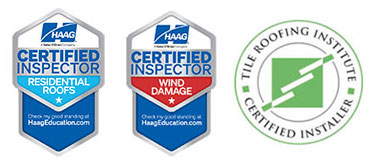
While many contractors learn on the job, we back our craftsmanship with respected industry certifications and state licensing. Our team brings forensic inspection training, licensed drone inspections, and building science knowledge to every project.
HAAG Certified Inspector (Residential Roofs & Wind Damage)
- What it is: HAAG certifications are considered the gold standard in the roofing industry for damage assessment and inspection. Certified professionals receive rigorous forensic training to evaluate weather damage, aging, design flaws, and installation defects on residential roofs.
- Requirements: Completing intensive coursework, passing comprehensive forensic damage exams, and submitting to ongoing annual recertification.
- Why it matters to clients: HAAG training is widely recognized throughout the insurance industry. A HAAG certified inspector is trained to distinguish normal wear and tear from storm damage and to document findings in terms insurance professionals recognize.
- What it means for your project: Clear, well-documented inspection reports that can support your conversations with your insurance carrier.
Certified HAAG Roofing Inspector | HAAG Inspector Search
Tile Roofing Industry Alliance (TRI Alliance) Certification
- What it is: A specialized credential focusing strictly on concrete and clay tile roofing systems, issued by the Tile Roofing Industry Alliance. It emphasizes adherence to building code requirements, high-wind application guidelines, and proper flashing and underlayment techniques.
- Requirements: Completing TRI’s code-based technical curriculum (including regional and high-wind installation codes) and passing a rigorous technical exam, with recertification required every two years.
- Why it matters to clients: Tile roofs are heavy, complex, and prone to leaks if installed improperly. Certification shows the contractor has been trained in the structural loading, underlayment layering, and fastening methods a tile roof requires.
- What it means for your project: Your tile roof is handled by a company trained in code-based methods for wind resistance, weather protection, and long-term performance.
Tile Roofing Industry Alliance Certified | TRI Membership Search
Building Science Principles (BSP)
- What it is: A knowledge-based credential from the Building Performance Institute (BPI) covering how a home’s building envelope, insulation, ventilation, and mechanical systems work together as one system.
- Requirements: Passing BPI’s Building Science Principles exam, a 100-question test covering building envelope performance, insulation, air sealing, and mechanical systems.
- Why it matters to clients: Building science training gives our team the background to recommend energy-efficient and ventilation products suited to how your home actually performs, rather than a one-size-fits-all upgrade.
- What it means for your project: Better-informed recommendations when it comes to ventilation and energy-efficient improvements for your home.
Building Science Principles Certification
FAA Licensed Drone Pilot
- What it is: A federal license issued by the Federal Aviation Administration (FAA) under 14 CFR Part 107. It grants legal authority to fly Unmanned Aircraft Systems (drones) for commercial and inspection purposes.
- Requirements: Passing the FAA’s aeronautical knowledge exam at an FAA-certified testing center, clearing TSA background vetting, and completing recurrent FAA training every 24 months.
- Why it matters to clients: High-resolution aerial imaging allows detailed inspections of steep, high, or hard-to-reach roofs while reducing the need to walk on them, which helps protect roofing materials and keeps crews safer.
- What it means for your project: Detailed visual inspections, conducted in line with federal drone regulations, with less foot traffic on your roof during the assessment.
Certified Remote Pilot Certification
Contractors State License Board (CSLB)
- What it is: The official state licensing authority regulating construction trade contractors. Holding an active license signifies the contractor is legally authorized to execute work in their trade classification.
- Requirements: Demonstrating a minimum of 4 years of journey-level experience, passing trade and business law exams, undergoing a criminal background check, posting a contractor’s license bond, and meeting the state’s workers’ compensation requirements.
- Why it matters to clients: This is the baseline of consumer protection in California. It confirms you are working with a state-vetted contractor who meets California’s bonding and insurance requirements.
- What it means for your project: Confidence that your project is handled by a contractor licensed and regulated by the State of California.
Ready to Work with Certified Experts?
Don’t settle for guesswork when it comes to your property. Contact us today for a comprehensive, expert inspection and estimate.